Page loading...
Shopping Cart


Rules
The rules are also available for download in .pdf format.
Cards and Concepts
Each player has a protagonist, a single woman of marriageable age. Your goal is for her to marry a desirable suitor, a man of good character and social standing.
Places for Cards
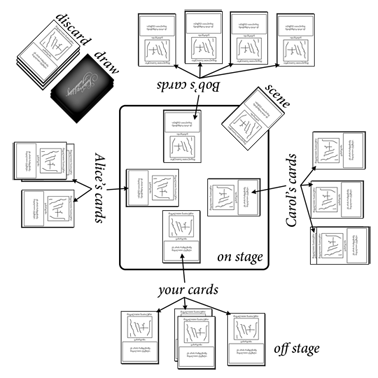
table layout
Cards not in play can be:
- face-down on the draw stack,
- face-up on the discard stack,
- in someone’s hand,
- or out of the game entirely.
When you have a card in play, it can be:
- off stage (right in front of you)
- or on stage (in the middle of the table, participating in the current scene).
Your cards on the table (not including cards in your hand) are the ones you have. Make sure to keep your cards facing you so you can tell which cards you have, and which cards other players have.
Moving Cards
When a card tells you to take another player’s card in play, turn that card so it faces you. Giving a player a card in play works the same way. Drawing a card means taking the top card from the draw stack and moving it to your hand. Discarding is sending a card from your hand to the discard stack. Dismissing a card is sending a card from in play (either on or off stage) to the discard stack.
Types of Cards
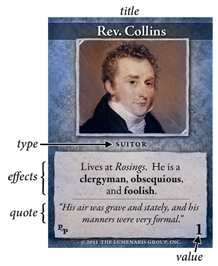
an example card
There are 8 types of cards in Suitors & Suitability:
- Protagonists are young women looking to marry. You’ll have the same protagonist for the entire game.
- Suitors are gentlemen desiring marriage.
- Supporters are other characters.
- Modifiers change the nature of other cards.
- Scenes describe the setting.
- Developments change the game.
- Incidents are events that happen.
- Reactions are responses to events.
Most cards have a quote from the book right after the effect text. The quote is just for enjoyment — it has no in-game effect.
Some cards have a number in their lower right-hand corner. This is the card’s value at the end of the game.
Playing the Game
Start by taking the protagonists out of the deck. Each player chooses a protagonist; any that aren’t chosen are out of the game. The rest of the cards make up the draw stack; shuffle it and place it face down on the table. Each player draws a hand of five cards from the draw stack. Choose a player to go first. After a player’s turn, play proceeds to the left.
On your turn, you go through three phases:
- play as many cards as you like,
- discard ones you don’t want,
- then draw enough cards to refill your hand.
Play Phase
During the play phase, you may play any number of cards from your hand. Each card has its own effects, so read the card to see what it does.
- Protagonists, suitors, supporters, and developments are played off stage. Put them on your area of the table, making sure they’re facing you so everyone knows they’re yours. It’s important to know who has which cards on the table.
- Modifiers are applied to a card that’s in play. Put the modifier under the card that it modifies, but leave the top of it sticking out so you can see the title.
- When you play an incident, it doesn’t matter where it goes. Just show it to everyone, carry out whatever effects it has listed, then put it on the discard stack.
- When you play a scene, it goes anywhere on the table; it doesn’t matter who it’s facing. Everyone on stage moves off stage. If there’s another scene already in play, the old scene is dismissed to the discard stack. Scene cards say that various people attend the scene – this means that if you have one of those people in play, you move them from off stage to on stage.
- A reaction can only be played as a response to something happening. For example, Urgent Business is a reaction to someone moving on stage. This means that whenever someone moves on stage, you can play Urgent Business. It doesn’t matter if it’s your turn or someone else’s. Once a reaction is played, it goes to the discard stack.
Thwarting an Action
Some cards say that they thwart an action or a card being played. This means that the action/card never takes place. Thwarting a card means you stop it from ever being played, while dismissing a card means you send it away after it’s already been played.
For example, let’s say Alice plays Vile Slander, but you don’t want her to. Wrath of de Bourgh is a reaction that can thwart any card being played. So if you have Wrath, you can play it as a reaction to Vile Slander being played to prevent its effects from happening. Both cards then go to the discard stack.
Willingness
Some cards may only be played if someone in play is willing. Proposal of Marriage, for example, may only be played on a willing protagonist. This means that if the player who has that protagonist doesn’t approve, the Proposal is thwarted.
Conflicting Effects
If two cards’ effects conflict with each other, resolve them according to these two rules:
- A card already in play takes precedence over a card being played.
- A reaction takes precedence over the card it’s reacting to.
For example, if Force of Honor is in play on Mr. Darcy, and then Unexpected Visitor is played to move Mr. Wickham on stage, this causes a conflict. Because Force of Honor was already in play, its effect takes precedence over that of Unexpected Visitor, and therefore Wickham cannot move on stage.
Forced End of Turn
A few cards cause your turn to end. When this happens, you can’t play any more cards, but your discard and draw phases still happen as usual.
Discard Phase
Once you have no more cards you’d like to play, discard as many cards as you like — or none, if you want to keep all the ones you have.
Draw Phase
If you have fewer than 5 cards in your hand, draw until you have five. When the draw stack runs out, shuffle the discard stack and flip it over as the new draw stack, then continue drawing cards as needed.
Becoming Obsolete
As conditions in the story change, cards can become obsolete. For example, Conflicting Pride is meaningless once Lady Catherine has left the game. If all players agree, a card can be declared obsolete. If you draw an obsolete card, remove it from the game and draw another. If an obsolete card is in play, remove it from the game.
Victory
Certain cards, like A Delightful Wedding, cause you to collect points. When this happens, your protagonist is now married. You collect points for the value of your protagonist + the value of her suitor + the value of modifiers on them + bonus points.
The first player to collect points earns 3 bonus points for going first. The second player to collect points earns 2 bonus points, and the third player earns 1 bonus point. Subsequent players earn no bonus points.
After you’ve collected points, your turn ends, and your protagonist and suitor are out of the game. Dismiss any other cards on them. You may still play cards, but you may not earn any additional points. Once all protagonists are married, or there are no more suitors to marry, the game is done.

back to Suitors & Suitability
© 2010-2019 The Lumenaris Group, Inc.
Lumenaris is a trademark of the Lumenaris Group, Inc. See notes for our terms and conditions, including our return and cancellation policies. If you'd like to learn more about how you can carry Lumenaris products, read about becoming a retailer.